
Free HECS-HELP Repayment Calculator 2026-27
Estimate your student debt repayment obligations under the new marginal threshold system.
Annual Repayment
$2,321
Net After HECS
$82,679
Privacy-First: We never see or store your financial data
Multi-Threshold Logic • Fast Results • No Account Required
Includes taxable income, fringe benefits, and net investment losses.
HECS-HELP Result
Repayment logic
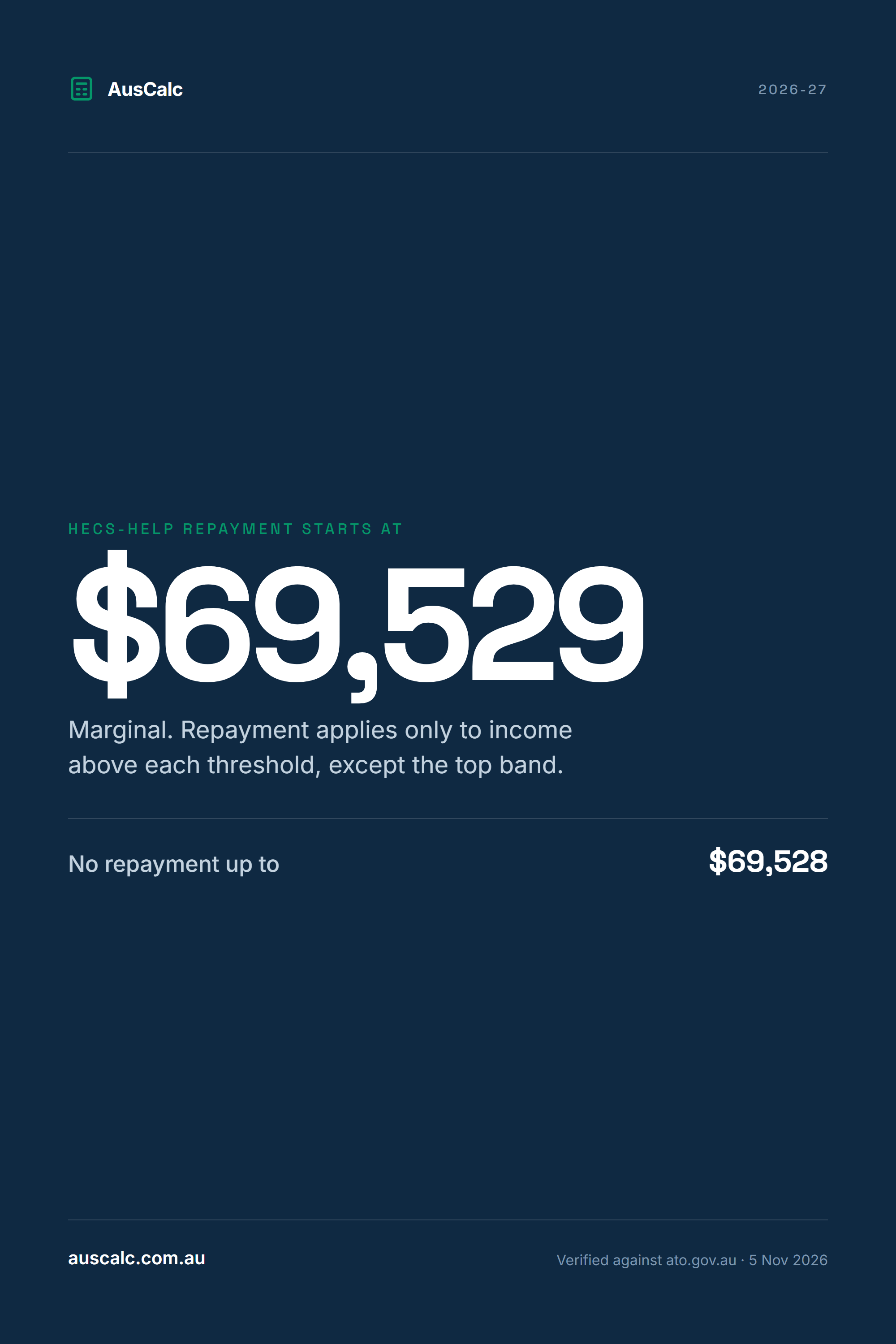
In the 2026-27 tax year, the HECS marginal system operates with no compulsory repayment outstanding on repayment incomes under $69,528.
Buying a vehicle or equipment
Financing a vehicle or equipment while you pay this down? A licensed asset finance broker we work with can quote the finance.
Get a finance quotePremium Australian Business Intelligence
HECS-HELP Repayment Report
Mandatory student loan repayment estimation for the 2026-27 Australian financial year.
Scenario Parameters
Financial Analysis
This document provides calculated estimates based on public Australian Taxation Office (ATO) guidelines and typical business parameters for the 2024-2026 financial years. AusCalc provides these models for strategic planning purposes only. These figures do not constitute personal financial, legal, or professional tax advice. Actual results depend on individual tax structure, deductions, and legislation changes. We mandate that you verify these projections with a Register Tax Agent or Financial Advisor before executing business strategies.
Invoice the job and see the tax to set aside, HELP repayment included.
Related Calculators
Regulatory Notice:
Standard ATO estimates only; consult a professional before acting. For more details, see our Disclaimer.
Related Tax Tools
Understanding HECS-HELP Student Debt Repayments (2026-27)
How This HECS-HELP Calculator Works
This comprehensive student debt estimator determines your mandatory debt repayments by aligning your total repayment income against the official ATO thresholds for the 2026-27 tax year. Under the marginal repayment system that applies from 2025-26 onwards, your repayment works like income tax brackets: you only repay on the income ABOVE each threshold, not on your whole income. Nothing is payable below $69,528, then 15c per dollar applies between $69,528 and $129,717, then $9,028 plus 17c per dollar above $129,717, capped at 10% of total repayment income from $186,051.
When you enter your expected annual input, the calculator applies the exact marginal formula, calculates your annual compulsory repayment, and determines your final net cash flow after both primary income tax and HECS/HELP obligations are satisfied.
Step-By-Step HECS Repayment Scenario (2026-27)
Let's step through a worked numerical example for a professional earning an annual taxable salary of $82,000 who has an active HECS study debt.
Gross ($82,000) - Tax ($16,760.00) - HECS ($1,870.80) = $63,369.20
Monthly HECS-HELP Payroll Deduction: $155.90
During the financial year, your employer deducts approximately $155.90 each month on top of your standard income tax withholding. This withheld cash is transferred to the ATO and officially credited against your help debt balance when you file your annual tax return.
Who Should Use This HECS-HELP Calculator?
This utility is highly helpful for Australian university students transitioning into full-time work, corporate employees checking why their tax return resulted in a debt, mortgage brokers verifying a client's debt-to-income limits, and payroll managers validating that payroll software is deducting the correct percentage for employee study loans.
Important HECS Repayment Rates for 2026-27
Under the marginal repayment system, compulsory repayments apply only to the income above each threshold, not to your whole income:
- Below $69,528 Repayment IncomeNil (No Compulsory Repayment Required)
- Between $69,528 and $129,71715c for each $1 over $69,528
- Between $129,717 and $186,051$9,028 plus 17c for each $1 over $129,717
- $186,051 and Over10% of your total repayment income (Maximum)
Frequently Asked Questions (FAQ)
Does making a voluntary payment reduce my compulsory HECS tax obligation?
No. Making a voluntary payment directly to the ATO via your myGov login reduces the total balance of your student loan, but it does not remove your liability for a compulsory repayment in that same financial year if your repayment income exceeds the $69,528 threshold.
Why do HECS-HELP repayments lead to a tax bill at the end of the year?
If you have multiple employers, or if you didn't check the "HELP debt" box on your TFN declaration, your employers won't withhold the additional repayments throughout the year. When you file your tax return, the ATO combines your income, calculates your total repayment, and presents a bill for the entire amount.
Does having a study debt affect my borrowing capacity for a mortgage?
Yes. Banks and mortgage assessors evaluate your net take-home pay when assessing borrowing capacity. Since HECS-HELP compulsory repayments reduce your net take-home pay (often by hundreds of dollars per month), it significantly lowers your calculated capacity to service a home loan.
How does indexation work under the lower of CPI or WPI rules?
Following recent legislation changes, indexation is calculated using the lower of the Consumer Price Index (CPI) or the Wage Price Index (WPI). This protects borrowers from massive indexation spikes during high-inflation periods, keeping indexation more aligned with growth in wages.
Are repayments deducted before tax or after tax?
HECS-HELP compulsory payments are calculated as a percentage of your gross income, but they are paid using after-tax dollars. They are not a tax-deductible expense, so they do not reduce your taxable income. Your employer handles this by withholding extra cash from your net salary.